Research / Engineering Capacity OS / Working Paper
Engineering Capacity as an Operating System
A working model for deciding how human judgment, AI agents, engineering knowledge, telemetry, and governance should operate together across the AI SDLC.
Author: Lonnie McRorey, Founder and CEO, TeamStation AI, Boston, Massachusetts. ORCID: 0009-0001-5351-190X. Status: working research model for review and testing, not a universal topology, delivery guarantee, or final peer-reviewed finding.
Abstract
The AI SDLC changes engineering capacity because work now moves through humans, AI agents, repositories, tools, policies, and review gates. The paper proposes that CTOs and CIOs treat those parts as one operating system, not as separate hiring, tooling, and automation decisions.
The model places humans where intent, architecture, judgment, approval, exceptions, and accountability are required. It places agents inside bounded tasks with known permissions, context, evaluation, and escalation. The paper does not prescribe one universal team shape.
What the Paper Contributes
- Leadership problem: More people or more AI agents do not create usable capacity when ownership, knowledge, review, and delivery controls remain weak.
- Topology model: Capacity comes from the arrangement of human judgment, bounded agent capability, durable knowledge, execution rules, telemetry, and governance.
- Evidence rule: Every recommendation must separate what is observed, modeled, directional, unknown, opinion, hypothesis, future work, internal research, or externally validated.
- Control boundary: A leader should know which source supports a recommendation, what remains unknown, and where human approval is still required.
How the Research Is Controlled
These supporting diagrams show how sources enter the paper and how evidence quality limits a recommendation. They document the research controls behind the argument.
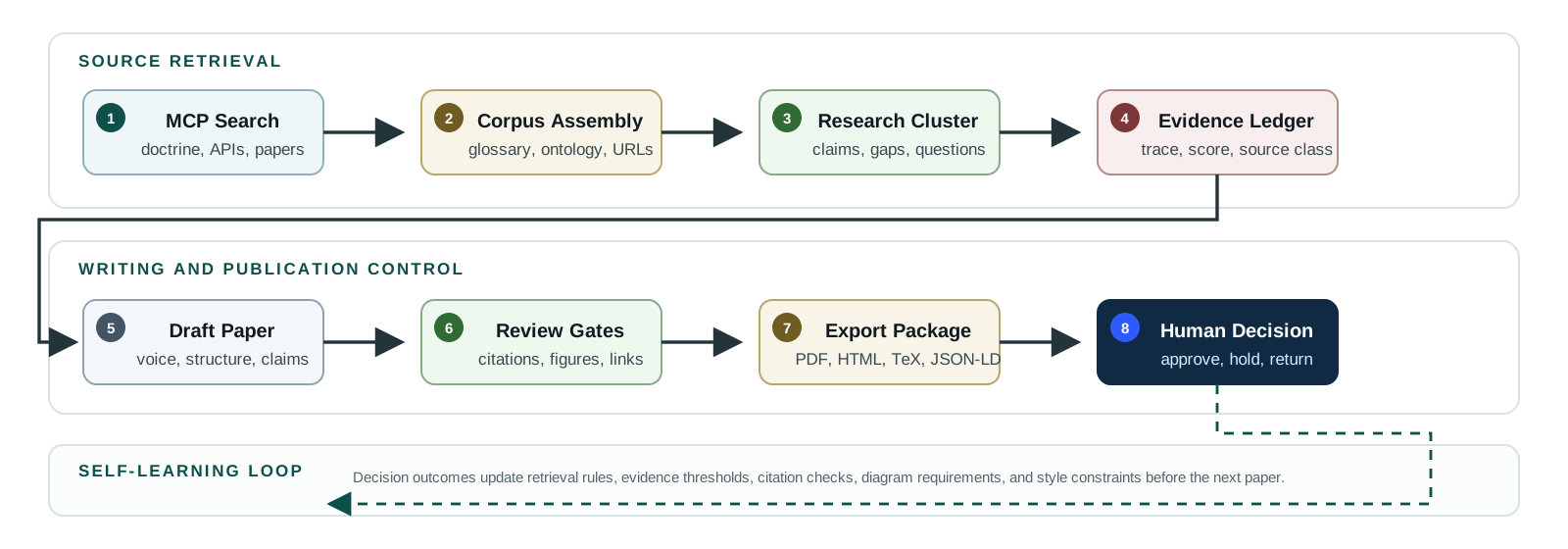
Purpose: Show how source retrieval, evidence review, drafting, and release controls support the working paper.
Use: Use it to inspect where evidence enters the paper and where human review can stop unsupported claims.
Output: A traceable paper with reviewable sources, figures, references, and validation records.
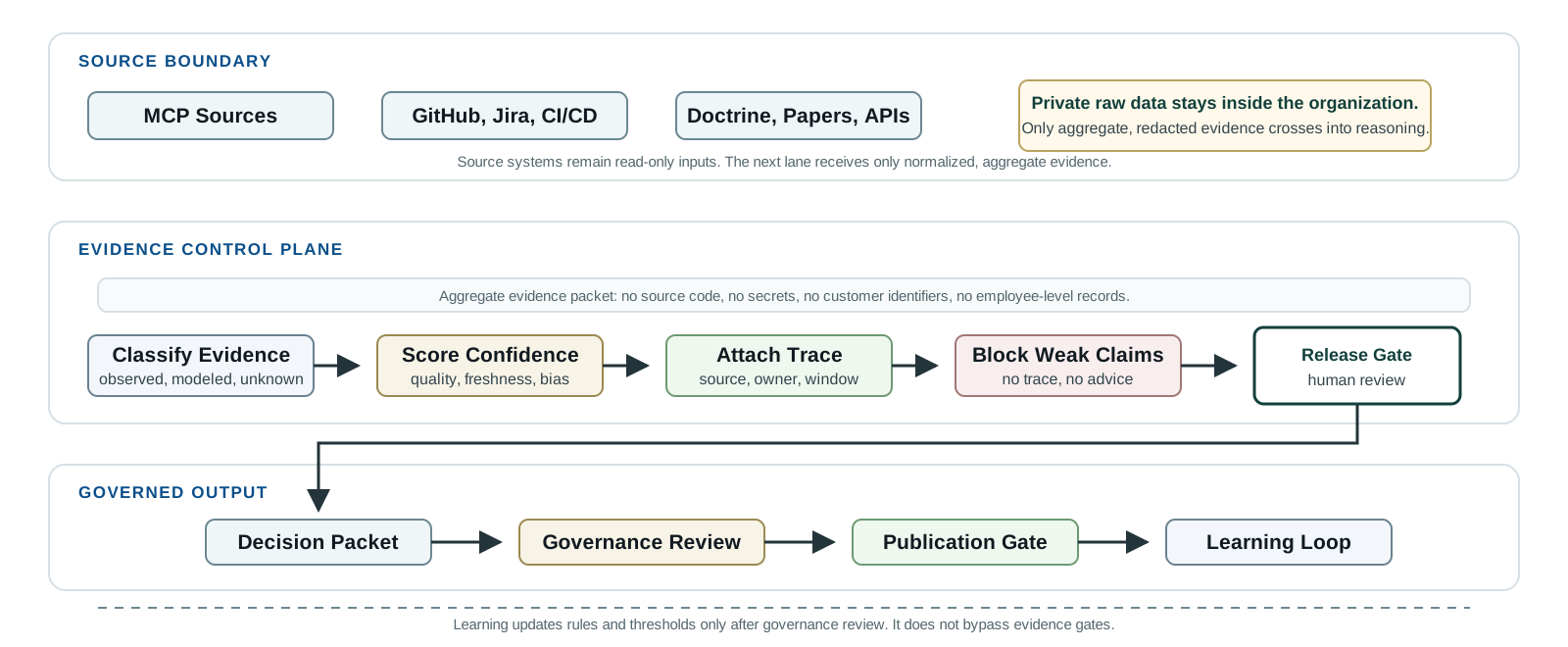
Purpose: Show the control boundary that keeps weak evidence from becoming a confident engineering recommendation.
Use: Use it to inspect source quality, confidence, traceability, governance, and human approval before action.
Output: A bounded recommendation with evidence class, confidence limit, source trace, and next safe action.
Read, Cite, and Review
Start with the browser or PDF version. The remaining formats support accessibility, citation review, research deposits, and reproducibility.
- Read in the browser: Open the complete working paper as an accessible web document.
- Download the PDF: Use the portable version for executive, participant, and research review.
- Read the Markdown: Use the plain text version for accessible reading and approved AI retrieval.
- Review the TeX source: Inspect the source prepared for a possible future research submission.
- Review the references: Inspect the bibliography used for citation review.
- Research source register: Review the public TeamStation research and doctrine connected to the paper.
- Paper metadata: Review the paper identity, author, keywords, version, and research status.
- Zenodo metadata: Review the draft metadata prepared for a possible future research deposit.
- Research process figure: Download the figure showing how sources and review gates support the paper.
- Evidence control figure: Download the figure showing how evidence quality limits a recommendation.
- Evidence classification table: Review the evidence states used to separate facts, models, unknowns, and hypotheses.
- Research source archive: Download the current source archive. A formal submission still requires human review.
Research Sources and Supporting Doctrine
These public sources connect the working paper to TeamStation research on distributed engineering, cognitive fidelity, team topology, agentic workflows, and delivery governance.
- Distributed Engineering Operating Systems
- Axiom Cortex for LATAM Agentic Engineering
- TeamStation Distributed Engineering OS
- Cognitive Fidelity and the Turing Trap
- Agentic Team Topologies for CTOs and CIOs
- Software Engineering Team Topologies for 2026
- Hidden Math of Distributed Engineering Failure
- Engineering Capacity Operating System Research
- Engineering Capacity Operating System Markdown Source
- Cognitive Fidelity Doctrine
- Agentic Engineering Workflows Doctrine
TeamStation AI Entity Links
The working paper is connected to the Engineering Capacity OS hub, the diagnostic question engine, the TeamStation AI parent entity, Distributed Engineering Operating System, Axiom Cortex, Nebula, Engineering Telemetry, AI Delivery Governance, and Agentic Development Workflow.
- Engineering Capacity OS research hub
- Engineering Capacity OS question engine
- Engineering Capacity OS research JSON
- Research Evaluation Protocol
- TeamStation AI parent entity
- Nearshore software development platform
- LATAM engineering teams
- CTO nearshore software development
- CIO nearshore governance
- Nearshore Control Plane
- Axiom Cortex engineer vetting
- Nebula AI Talent Graph